



US Army engineers develop packaging to extend shelf life, reduce waste and harness and store energy | 15-01-2026 |
It’s been a while since we took a look at the overcrowded space of R&D in the field of flexible films to help reduce spoilage and extend the shelf life of perishable or sensitive foodstuffs. It seems that there is no let-up in the number of universities or research establishments – both private and public – operating in this space. With the caveat that not everything will come to market, here is one development which is likely to see the light of day due to its military provenance.
The US Army Combat Capabilities Development Command Soldier Center's Combat Feeding Division in Natick, Massachusetts, deployed about a half-dozen engineers to focused on nothing but packaging. With military rations, including meals, ready-to-eat and supplemental bars, packaging is a crucial part of preserving the food's freshness and extending shelf-life stability, so troops stay provisioned during important missions. While the rations themselves go through a lot of trial and error, so, too, does the packaging.
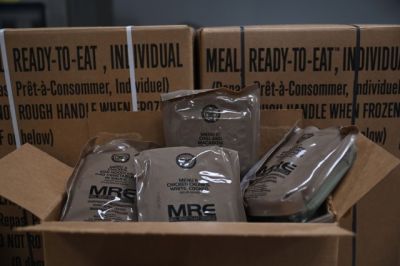
For the unfamiliar, MREs (Meals, Ready to Eat) come in one large plastic bundle with several smaller packages inside consisting of an entree and supplemental snacks and drinks. These rations are packaged in three or four layers of materials, depending on the product, to protect food from the elements and preserve freshness until opened.
"There are 10, 15, maybe even 20 components in an MRE, and each one of those has their own specific package," said Danielle Froio-Blumsack , a materials engineer on the division's Food Protection and Individual Packaging Team. "That's a large amount of packaging waste to dispose of, and it's an issue for the Army. It's also an environmental and health hazard."
The lab's specialists run most of the entrees through a retort process, which hermetically seals them into sterilized packaging via a pressurized chamber to extend product shelf life without the need for preservatives. Current retort pouches have three layers of blended polymers and a foil layer that keeps water vapour, oxygen and light out. "You need to have low permeation... because that allows you to extend the shelf life and improve the overall quality for the warfighter," Froio-Blumsack said.
Unfortunately, the foil isn't recyclable, so FPIPT personnel created a new polymer blend with similar properties that weighs significantly less and meets shelf-life requirements. It doesn't meet water vapour transmission rates, however, so experts are determining if they need to rework their requirements. Some of the new, non-foil pouches spent five years in storage and recently passed food safety and quality testing in the division's microanalytical and sensory evaluation labs.
However, it takes a long time for new materials to make it onto the battlefield. "It's been seven years for this project, and it's still just on the cusp of being able to go out into the field," she said.
The lab works with academia and industry to create new materials and find commercially available technologies that can be formulated to meet military needs. One project that's in the early stages collaborates with Purdue University on energy harvesting, which converts ambient energy into usable power. The lab is looking at doing so by putting what are called tribal voltaic nanogenerators on patches that would go on pallets of boxed rations.
"Within each one of these little patches are... two layers of material that, when they vibrate or shake or move in any way, their vibrational energy can be harnessed and stored as energy," Froio-Blumsack explained. The hope is that during the logistics cycle when pallets of rations are moved and bounced around through air, ship or truck they could harvest enough energy to potentially heat a ration instead of needing the flameless ration heater currently used by troops. In Arctic conditions, the process could prevent rations from freezing, she said.
The FPIPT has also worked closely with NASA to extend the shelf life of astronaut food in preparation for future missions to Mars.
ALL AT AIPIA/AWA SMART PACKAGING WORLD CONGRESS 2026