


AIPIA/AWA World Congress Wrap: Winners of the Brand Challenge 2026 - Advancing Cranswick’s “Perfect Pack” Vision | 14-06-2026 |
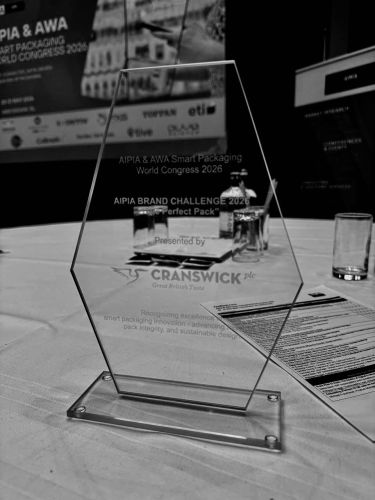
The Active & Intelligent Packaging Industry Association (AIPIA), and AWA Alexander Watson Associates, is pleased to announce the winners of the AIPIA Brand Challenge 2026, held during the AIPIA & AWA Smart Packaging World Congress - the leading global platform for active and intelligent packaging innovation. Hosted annually by AIPIA, the Brand challenge is one of its key highlights of the event, held annually in Amsterdam and has involved many leading Brand owners who present real-world packaging challenges and invite the AIPIA community -technology providers, innovators, and packaging experts to pitch live solutions.
This year, Cranswick PLC, a leading UK-based food producer, presented its “Perfect Pack” challenge, seeking smart, scalable packaging solutions that can monitor product condition, enhance food safety and shelf life, improve traceability and authenticity, and support sustainability and regulatory compliance, ultimately delivering packaging that can verify itself, protect itself, report its condition, and digitally connect across the supply chain and with consumers.
Selected participants pitched their solutions live on 21 May to the Cranswick evaluation team, including Clive Stephens, Head of Research & Development at Cranswick PLC, demonstrating technologies ranging from smart sensing and digital traceability to anti-counterfeiting and recyclable smart packaging concepts. Following a highly competitive session, the judging panel selected the winners based on innovation, feasibility, and real-world impact:
First place went to Xordex Ventures. The company’s Hashentic product pairs embedded NFC tags with a tamper-evident digital record, so consumers, partners and regulators can verify the origin, journey, and integrity of a physical item in one tap. Each product is equipped with a secure NFC tag, QR code, or GS1 identifier, ensuring a unique and tamper-proof digital identity from the moment it enters the supply chain. Product information — such as origin or composition — is securely stored within the Hashentic platform. Customers and partners tap or scan the product to verify authenticity and access trusted digital content — no app is required. Verified users can also update NFC tags directly using their smartphone. Brands receive real-time analytics and lifecycle visibility, including scan locations, engagement metrics and product status updates. It is a foundation for Digital Product Passports, anti-counterfeit programmes and circular-economy flows, the company believes.
Second place honours were awarded to Luchrome. This company has designed a new way to interact between a product and its user through a form of ultra-low-power display using E-Paper technology, which takes on the appearance of a sheet of paper. During the Challenge it demonstrated the potential of its Lusight technology, focusing on addressing one of the food industry's biggest challenges: reducing waste, while improving consumer engagement. Unlike conventional labels, it enables information displayed on packaging to be updated dynamically throughout a product's lifecycle. This opens the door to a new generation of smart labels capable of communicating relevant information directly to consumers and supply chain stakeholders such as dynamic expiration and freshness information, real time promotional content and enhanced traceability. Other applications include medical diagnostics and consumer electronics.
The final classification on the podium went to Lasso Loop Recycling. This company is developing a home recycling appliance that lets consumers bypass the current ‘ineffective’ curbside system almost completely. The Lasso accepts and sorts seven different types of materials: PET and HDPE plastic; brown, green and clear glass; aluminum and steel cans. Once in the machine, sensors and cameras check if it can actually be recycled. As well as scanning the size and shape of the item, cameras also look for any barcodes that can help detect material type. If it's not an accepted material, or if there's an issue like a bottle cap left on, the machine will reject it. If it passes the test, the Lasso washes the item to remove contaminants and removes any labels. The labels waste is stored and can be discarded. Once clean, materials move to a processor, which grinds up each item and spits the pieces out into separate containers at the bottom of the machine ready for periodic collection.
AIPIA and AWA congratulate all participants for their outstanding contributions and innovative approaches, which once again highlighted the power of collaboration between Brand owners and the smart packaging ecosystem in accelerating next-generation packaging solutions.